You know that feeling when you nail a jerk chicken that actually tastes like the islands — the kind with deep, smoky, slightly sweet heat that lingers without scorching — and someone at the table asks, “what’s in this?” The honest answer, more often than not, is that the magic lives in the base ingredients, not just the sauce you drizzle at the end. Two products that seasoned Caribbean scratch cooks quietly rely on — and that newcomers almost always overlook — are fermented scotch bonnet pepper mash and dry jerk seasoning. Scotch bonnets are the small, lantern-shaped peppers that define Caribbean heat; they’re related to habaneros but carry a fruitier, more complex flavor. Fermented mash is those peppers blended and salt-cured into a paste that cooks use as a building block, the way an Italian cook might reach for tomato paste rather than a finished marinara. Dry jerk is a spice-blend rub — allspice, thyme, scotch bonnet, and more — without the vinegar or oil of a wet paste, which changes how and when you use it. This guide will show you exactly where these two formats fit in a serious Caribbean pantry, and how to decide which ones to buy.
| EDITOR'S PICKAashirvaad Whole Wheat Atta 11lb | Mid-tierIsland Spice Jerk Seasoning 32… | Budget pickGrace Jamaican Dry Jerk Seasoni… | |
|---|---|---|---|
| Net Weight | 11 lb | 32 oz | 12 oz (2 x 6 oz) |
| Format | Flour (atta) | Dry seasoning | Dry seasoning |
| Pimento Listed | — | ✓ | — |
| Gluten-Free | — | ✓ | — |
| Vegan-Friendly | — | ✓ | — |
| Pack Count | 1 | 1 | 2 |
| Price | $27.99 | $22.97 | $17.99 |
| See on Amazon → | See on Amazon → | See on Amazon → |
Why Finished Hot Sauce Isn’t Enough (And What’s Actually Missing)
If your current setup is a bottle of Marie Sharp’s or Matouk’s on the table, you have excellent taste. Those sauces are genuinely great. But they’re finished products — already seasoned, already acidic, already calibrated for a specific flavor profile. That’s a feature at the table and a limitation in the pot.
When you’re building a jerk chicken sauce from scratch, you want control over each layer: the raw pepper heat, the aromatics, the acid, the sweetness. A bottled sauce collapses those layers into one decision. Fermented scotch bonnet mash hands you the pepper layer separately, so you can calibrate the rest yourself.
Serious Eats’ overview of marinade science makes the underlying point clearly: acid and fat in a wet marinade affect surface flavor and tenderness, but they do so in competition with each other. A dry rub applied 24 hours ahead — or a fermented paste worked into the meat — allows flavor to penetrate differently and hold through high-heat cooking. This is the practical reason why serious jerk practitioners often combine both a dry rub phase and a wet sauce phase, rather than using one or the other.
Saveur’s feature on scotch bonnet peppers in Caribbean cooking describes fermented pepper preparations as a traditional preservation and flavor-concentration technique, distinct from a vinegar-forward hot sauce. The fermentation softens the sharpness and adds a slight funkiness — what some cooks call “depth” — that you can’t get from a fresh pepper or a shelf-stable sauce.
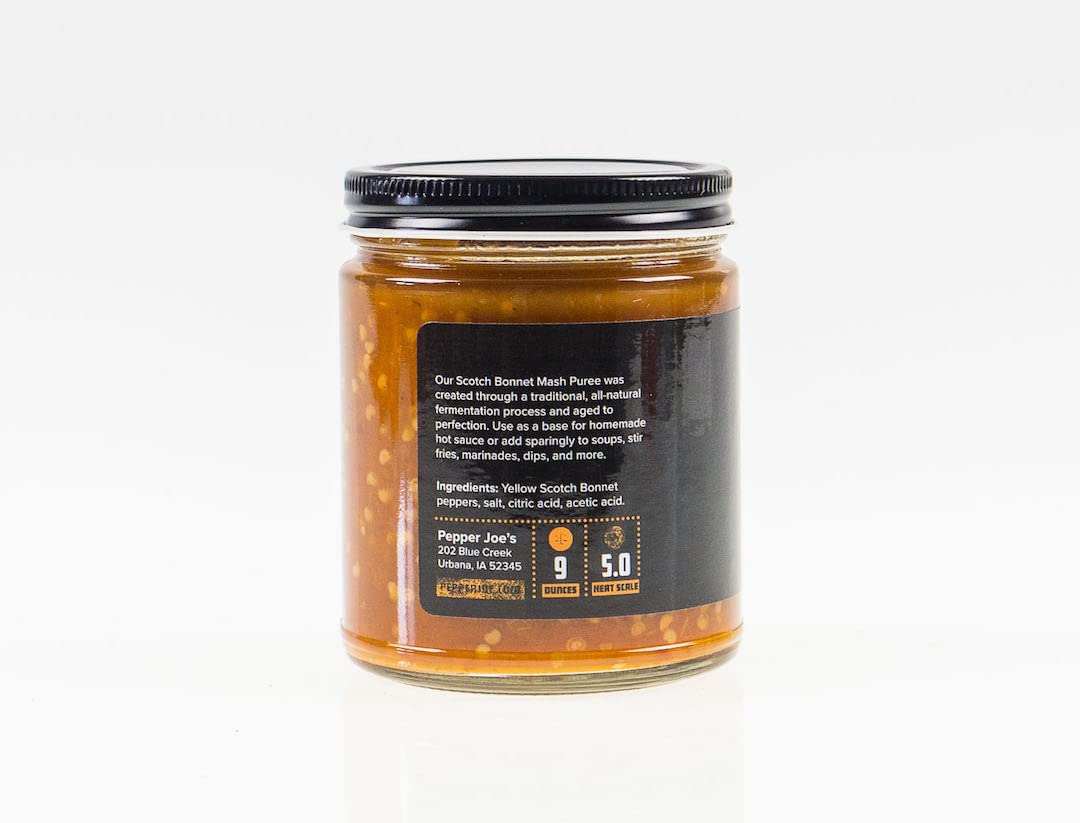
Pepper Joe’s Scotch Bonnet Mash: The Scratch-Cook’s Secret Weapon
Pepper Joe’s Scotch Bonnet Mash is the product that most clearly fills the “fermented base” slot in the scratch-cook pantry. What matters here is how people actually use it. Across aggregated buyer reviews, the pattern is overwhelmingly functional rather than condiment-style: reviewers consistently describe adding it to sauces, stews, rice dishes, and marinades — not spooning it directly onto food. One reviewer explicitly calls it “perfect for my jerk chicken sauce,” which tells you exactly what you’re buying: a component, not a finished product.
This framing matters when you’re pricing it out. At roughly $8–12 for a jar, the per-use cost is low if you’re deploying it as an ingredient. A tablespoon into a gallon of jerk marinade, a teaspoon into a pepper pot, a small spoonful into callaloo while it’s simmering — the jar lasts. Compare that to buying fresh scotch bonnets when they’re in stock (seasonally volatile, as any Caribbean grocery shopper knows), and the math shifts further in the mash’s favor.
Heat calibration note: Fermented scotch bonnet mash sits at a real heat level — scotch bonnets measure roughly 100,000–350,000 Scoville Heat Units (SHU), per Taste Atlas’s entry on the variety. The mash is not cut with vinegar the way most bottled sauces are, so start with less than you think you need when cooking for mixed heat-tolerance tables. This is a fire-breathing ingredient in raw form; it becomes family-dinner-safe once it’s distributed into a larger dish.
Dry Jerk: Two Very Different Products, Two Very Different Jobs
The dry jerk category is where practitioners often conflate things that should be separated. Island Spice Dry Jerk and Grace Dry Jerk are both legitimate, useful products — and they are not interchangeable.
Island Spice Dry Jerk: The Diaspora Authenticity Signal
Island Spice earns a specific kind of loyalty that’s worth naming: reviewers consistently identify it as the same product they purchased in Jamaica, and that provenance carries real weight. When a diaspora cook says “this is what I grew up with,” they’re not being sentimental — they’re describing flavor memory calibration that no reformulated export product can replicate.
The consistent note across buyer reviews is that Island Spice Dry Jerk is milder than expected, especially for shoppers accustomed to Walkerswood Hot & Spicy paste. This is genuinely useful calibration. The dry format naturally delivers less immediate heat than a wet paste (which concentrates liquid-soluble capsaicin against the meat surface), so if you’re used to the aggressive front-of-mouth heat in Walkerswood, Island Spice will read as restrained by comparison. That’s not a flaw — it’s a feature for building complex flavor without scorching the dish.
The Spruce Eats’ comparison of dry rubs and wet marinades reinforces why this matters: dry rubs form a bark or crust under high heat that seals in moisture and creates Maillard browning. A wet paste, by contrast, can steam the surface if it’s too thick, inhibiting the crust formation that gives properly jerked meat its texture. Island Spice in dry form is the right tool for the high-heat, direct-flame, or broiler application.
Grace Dry Jerk: The Finishing Seasoning Nobody Talks About
Grace Dry Jerk surprises people. The discovery hiding in buyer reviews is that a significant portion of users aren’t reaching for it as a marinade base at all — they’re using it as a finishing seasoning: on fries, on popcorn, on watermelon, shaken over buttered corn. This is worth surfacing as a genuine revelation rather than a curiosity, because it reveals something real about the product’s flavor profile. Grace Dry Jerk is balanced enough — the allspice, thyme, and pepper notes are legible without being aggressive — to function as a table seasoning in the way that Old Bay does in mid-Atlantic American cooking.
If you’re building a pantry for scratch cooking and you want to stock one dry jerk for marinades and one for finishing, Grace plays the finishing role clearly. If you want one product that does both, Island Spice’s authenticity and depth make it the stronger marinade anchor.
By the Numbers
| Product | Primary Role | Heat Level | Format |
|---|---|---|---|
| Pepper Joe’s Scotch Bonnet Mash | Fermented ingredient base | High (use sparingly) | Wet/paste |
| Island Spice Dry Jerk | Marinade rub, bark-building | Mild-medium | Dry |
| Grace Dry Jerk | Marinade or finishing seasoning | Mild | Dry |
| Walkerswood Hot & Spicy Paste | Wet marinade, reference point | High | Wet/paste |
The Roti Flour Connection: Atta and the South Asian–Caribbean Bridge
A quick note for pantry builders who are also sourcing roti flour: atta flour products on the Caribbean specialty market draw a loyalty pattern that mirrors the scotch bonnet mash story. Reviewers of atta flours — the finely milled whole-wheat flour that makes roti soft and pliable — consistently cite familiarity from South Asian households, not just Caribbean ones. This is historically accurate and worth making explicit: Caribbean roti tradition arrives directly from the indentured South Asian laborers who came to Trinidad, Guyana, and other islands in the 19th century. The flour is the same; the technique and seasoning diverge. If you have South Asian family members or friends who already know atta, you can shortcut the learning curve by starting with their technique and adjusting the filling and seasoning toward Caribbean flavor profiles. The diaspora overlap is real, and smart pantry curation takes advantage of it.
Frequently Asked Questions
What is scotch bonnet pepper mash and how is it different from a bottled scotch bonnet sauce? Scotch bonnet mash is a fermented or blended paste made primarily from scotch bonnet peppers and salt — sometimes with minimal additional ingredients. A bottled sauce adds vinegar, water, carrots, or other vegetables to create a finished, pourable condiment calibrated for table use. Mash is an ingredient you build with; sauce is something you add at the end.
Can I use fermented pepper mash directly on food or only in cooking? You can use it directly, but it’s intensely hot and salty in concentrated form, so most cooks don’t. Think of it the way you’d think of fish sauce or anchovy paste — technically edible straight, but best deployed as a flavor catalyst inside a dish rather than a standalone condiment.
How hot is the Island Spice dry jerk rub compared to Walkerswood Hot & Spicy paste? Milder, in practice, for two reasons: the dry format delivers less surface-contact capsaicin than a wet paste, and reviewers consistently describe Island Spice as restrained by Caribbean standards. Walkerswood Hot & Spicy paste is an aggressive, front-loaded heat product; Island Spice is a slower, more integrated warmth. If you’re heat-sensitive, Island Spice is the safer starting point.
Is the Grace dry jerk seasoning the same formula as their wet jerk paste? No. The dry and wet versions are distinct formulations. The wet paste carries more liquid-soluble heat and a vinegary sharpness; the dry version is balanced for broader application, which is why reviewers use it as a finishing seasoning rather than solely a marinade base. Don’t assume proportions transfer directly between the two formats.
How do I store an opened jar of fermented scotch bonnet mash? Refrigerate after opening, keep the lid tight, and use a clean utensil every time to avoid introducing bacteria. Fermented pepper products are preserved by salt and the fermentation process, but refrigeration significantly extends shelf life once the seal is broken. Most jars will last several months in the fridge with proper handling.
Can a dry jerk rub replace a wet marinade for oven-baked chicken? Yes, with one adjustment: add a small amount of oil to the surface of the chicken before applying the dry rub. This helps the spices bloom and form a crust under oven heat. The Spruce Eats notes that fat helps fat-soluble flavor compounds — including many in allspice and thyme — penetrate and adhere. Without some fat, a dry rub on lean chicken breast can taste dusty rather than integrated.
The Decision Rule
If you’re building a scratch-cook Caribbean pantry and you need a clear “if X, then Y” framework:
- If you want maximum control over heat in a marinade or sauce you’re building from scratch → prioritize Pepper Joe’s Scotch Bonnet Mash. It’s a raw ingredient, not a shortcut.
- If you want an authentic dry rub that forms a proper bark under high heat and carries diaspora provenance → Island Spice Dry Jerk is your marinade anchor.
- If you want a jerk seasoning flexible enough to finish fries, popcorn, or buttered corn and also work as a marinade base → Grace Dry Jerk earns its place as a pantry utility player.
- If you’re sourcing roti flour and have South Asian household connections → atta flour is the shared vocabulary; lean on that knowledge base and adjust from there.
None of these products replace your finished hot sauces. They sit upstream of them — the layer of the pantry where the real flavor architecture gets built.