You know that feeling when you’re standing in a tiny shop somewhere in the Caribbean — maybe a roadside market in Barbados, maybe a harborside deli in St. Thomas — and you pick up a bottle of hot sauce you’ve never seen before, taste a sample on a cracker, and think this is it, this is the one? You bring home two bottles. You run out in three weeks. You spend the next month trying to figure out where on earth to order more. That’s the purchase story that runs through nearly every review of the sauces in this guide — and it’s also the clearest signal that these bottles are doing something the mainstream shelf can’t replicate.
This guide covers five regional Caribbean pepper sauces that exist largely outside the Walkerswood-and-Matouk’s orbit: Aunt May’s (Barbados), Bertie’s Original (Trinidad), Mama Maisa’s (U.S. Virgin Islands), Ghost Island (extreme-heat, Caribbean-flavored), and Queen Majesty Scotch Bonnet & Ginger. For readers already comfortable reading a heat label and parsing ingredient lists, this is a comparison-focused breakdown — tradeoffs named explicitly, flavor profiles mapped to use cases, and a clear decision frame at the end. If you’re newer to Caribbean hot sauce geography, the on-ramp is gentle; the later sections go deeper.
| EDITOR'S PICKAunt May's | Mid-tierQueen Majesty Scotch Bonnet & G… | Budget pickGhost Island Hot Sauce | Extra… | |
|---|---|---|---|
| Size | 12 oz | 5 oz | — |
| Pepper base | — | Scotch bonnet, habanero | Habanero, bhut jolokia |
| Added ginger | — | ✓ | — |
| Vegetarian | — | ✓ | — |
| Gluten free | — | ✓ | — |
| No preservatives | — | — | ✓ |
| Price | $24.77 | $14.99 | $12.19 |
| See on Amazon → | See on Amazon → | See on Amazon → |
Why Regional Matters: The Geography of Caribbean Heat
Saveur’s deep-dive on Caribbean pepper culture makes a point that experienced sauce collectors already know intuitively: the Caribbean is not a monolith. The same scotch bonnet pepper (a cultivar clocking in at roughly 100,000–350,000 Scoville Heat Units, compared to Tabasco’s 2,500–5,000) gets treated radically differently depending on the island’s culinary tradition. Barbados leans on mustard-based carriers. Trinidad embraces the raw, fruity funk of Moruga peppers alongside scotch bonnets. The U.S. Virgin Islands produce sauces built for the confluence of West African, Danish colonial, and American mainland pantry traditions.
Taste Atlas’s Caribbean hot sauce overview notes that island-of-origin authenticity is one of the primary quality signals buyers use to distinguish artisan sauces from licensed facsimiles — a pattern our own audience knows well. The difference between tracking down a bottle someone’s aunt actually makes in Bridgetown versus buying a “Bajan-style” grocery label is the same difference as between Walkerswood and a supermarket knock-off. Provenance is the product.
By the numbers:
- Scotch bonnet: 100,000–350,000 SHU
- Trinidad Moruga Scorpion: 1,200,000–2,000,000 SHU
- Tabasco Original: ~2,500–5,000 SHU
- Ghost pepper (Bhut Jolokia): ~800,000–1,041,000 SHU
The Five Sauces, Ranked by Use Case
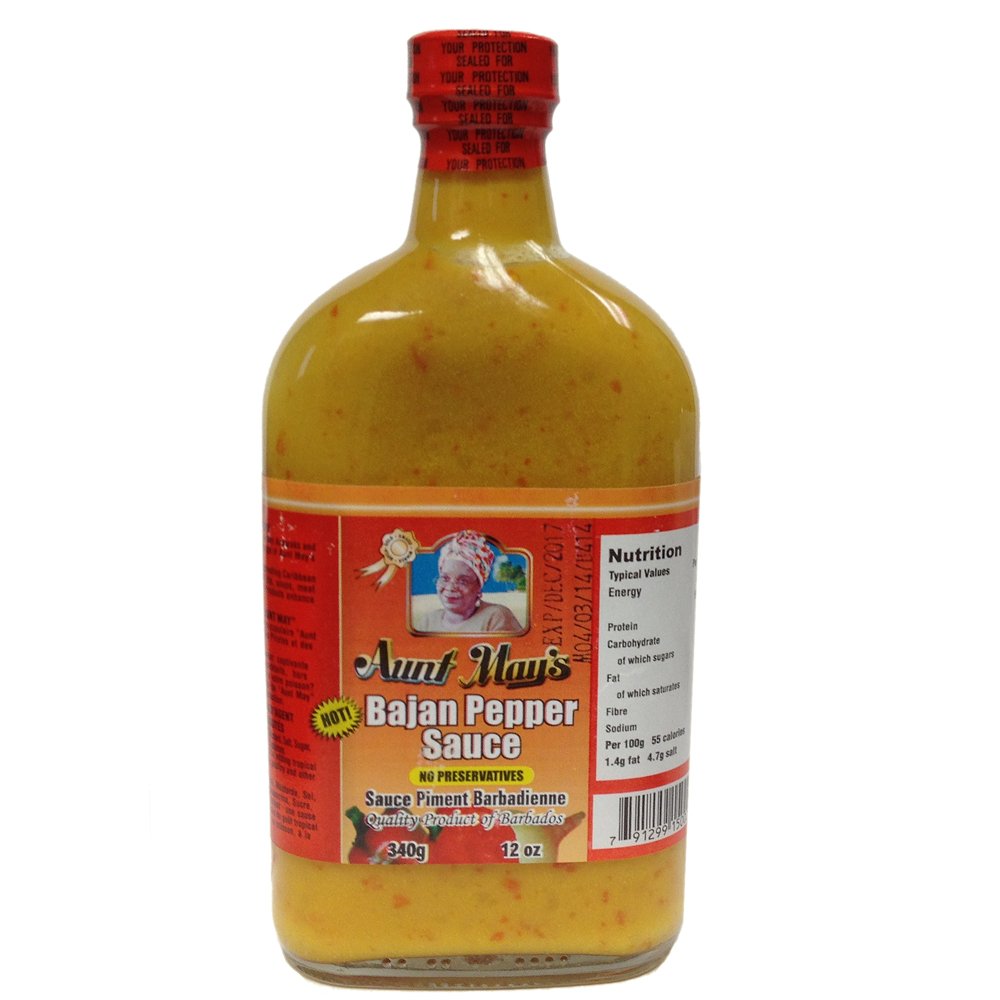
Aunt May’s Bajan Pepper Sauce — The Condiment Table Anchor
Bajan pepper sauce — “Bajan” is the demonym for Barbadian, used by Bajans themselves — follows a tradition that Serious Eats has described as distinctive among Caribbean regional styles for its mustard-and-turmeric base. Where Jamaican sauces lean fruity and fiery and Trinidadian versions emphasize chadon beni (also called shado beni — a narrow-leafed herb with a flavor profile somewhere between cilantro and culantro), the classic Bajan formula is tangy, golden, and aromatic before it’s ever hot.
Aunt May’s fits squarely in that tradition. Reviewers who found it in Barbados and then tracked it online describe it as genuinely homestyle — the kind of sauce that sits on the table at a family lunch rather than being wielded as a dare. Heat-literacy framing: family-dinner-safe. The mustard base means it pairs beautifully with fried fish, cou-cou (a cornmeal-and-okra dish that is Barbados’s national dish), and roast chicken. It also makes an outstanding base for a quick Bajan-style vinaigrette if you whisk it with lime juice and neutral oil.
Tradeoff to name explicitly: If you want the unfiltered scotch bonnet heat experience, Aunt May’s is not your bottle. The mustard carrier rounds the edges. That’s a feature for condiment-table use and a limitation for anyone building a cooking sauce where heat is the point.
Bertie’s Original Trinidad Pepper Sauce — The Emotional Anchor
The most emotionally resonant review pattern in the dataset for this guide belongs to Bertie’s, and it’s worth quoting the shape of it directly: buyers describe opening the bottle and being hit by an aroma that reads as homemade before the flavor even registers. One reviewer wrote simply: “Tastes like my mothers!” — no apostrophe error corrected, because the raw punctuation feels like the emotional urgency of the sentence.
What explains that reaction technically is the Trinidad Moruga pepper base. The Smithsonian Magazine’s profile of Caribbean pepper culture notes that the Moruga Scorpion (which originates in the Moruga district of southern Trinidad) has a unique aromatic front — floral, almost fruity — before the catastrophic heat arrives. Bertie’s uses this pepper in a way that reviewers consistently describe as balanced rather than punishing, which is a significant formulation achievement at that heat level. Heat designation: fire-breathing, handle with intent. This is not a Tabasco swap. On the Scoville scale, Moruga peppers can reach into the 1.2–2 million SHU range, making them among the hottest peppers measured by Winthrop University researchers (per Smithsonian’s coverage of the 2012 SHU confirmation study).
Decision frame: If you’re buying for diaspora-gift purposes and the recipient grew up in a Trinidadian household, Bertie’s is the bottle with the highest likelihood of generating that “tastes like home” response. If you’re buying for heat tolerance unknown, you are buying a challenge sauce — pair it with clear labeling for the recipient.
Cooking note: Because the Moruga base is so intensely flavored, a small amount goes further in a pot of pelau or curry than you’d expect. Reviewers who cook with it regularly report using quarter-teaspoon increments where they’d use a tablespoon of Tabasco.
Mama Maisa’s USVI Scotch Bonnet Sauce — The Technically Precise Pick
Mama Maisa’s draws a review that any serious sauce collector should read carefully: a buyer explicitly calls out the absence of water in the ingredient list as a quality signal, noting that the consistency is thicker and the flavor more concentrated as a direct result. This is not a trivial point.
Epicurious’s guide to Caribbean hot sauces notes that water dilution is one of the most common ways commercial producers extend volume without extending flavor. A no-water formulation means every gram of the sauce is doing flavor work — you’re paying for pepper, not for hydration. At a typical price point in the $12–18 range for small-batch artisan sauces of this style, a concentrated no-water sauce frequently wins on cost-per-use math even when it costs more per ounce than a diluted competitor.
Heat designation: confidently hot, not extreme. Scotch bonnet without the Moruga escalation means you’re in the 150,000–350,000 SHU range — serious heat with significant flavor complexity. Reviewers describe Mama Maisa’s as versatile across both condiment and cooking applications, which is the right read for a concentrated sauce: use it as a table condiment in small amounts, or cook it into a sofrito base, a marinade, or a stew where the concentration becomes an asset.
Tradeoff: The thick consistency means it doesn’t pour freely — it’s a spoon sauce, not a shake bottle. If your use case is a squeeze bottle at the table, this will frustrate you. If your use case is a small spoon into a hot pan, it’s exactly right.
Ghost Island Hot Sauce — The Flavor-First Extreme
Ghost Island occupies a specific niche that’s easy to mislabel. One reviewer explicitly compares it to “Dirty Dick’s Caribbean hot sauce” — a sauce known for its tropical fruit and curry notes — and identifies curry and mustard as the dominant flavor compounds before the pepper heat arrives. That framing is precise and useful: Ghost Island is not a one-dimensional scorcher. It’s a flavor-first sauce that happens to be extremely hot.
Ghost pepper (Bhut Jolokia) clocks in at 800,000–1,041,000 SHU. Combined with a curry-and-mustard flavor architecture, Ghost Island lands in a flavor lane closer to Indo-Caribbean cooking traditions (where curry is a pantry pillar, carried over from the indentured labor migration from South Asia to Trinidad, Guyana, and Jamaica in the 19th century) than to the pure-pepper traditions of Barbados or the eastern Caribbean.
Heat designation: fire-breathing, flavor-complex. This is the bottle for the buyer who finds most extreme sauces boring because there’s nothing to taste after the pain subsides. Reviewers who enjoy it tend to describe it as a sauce they reach for with grilled meats or roti — dishes with enough fat and body to carry the curry-mustard base alongside the heat.
Queen Majesty Scotch Bonnet & Ginger — The Depth Play
Queen Majesty earns a review specifically calling out its depth against sauces that are “just burn with no real depth” — a framing that signals a sauce-literate buyer who has burned through (pun intended) enough single-note hot sauces to recognize when one is doing more.
The ginger addition is the structural decision that changes how this sauce pairs. Ginger adds a bright, slightly camphor-adjacent warmth that is chemically distinct from capsaicin heat — it activates different receptors (TRPA1 versus the TRPV1 channel that capsaicin targets, per Serious Eats’ explainer on hot sauce chemistry). The practical effect is layered warmth that builds and releases differently than pepper heat alone, making the sauce particularly well-suited to applications where you want aromatic complexity: jerk marinades, glazes for roasted root vegetables, or a finishing drizzle over escovitch fish.
Heat designation: family-dinner-hot. The scotch bonnet base means real heat, but the ginger integration softens the pure-pepper aggression. Reviewers consistently describe it as the bottle they reach for when they want flavor alongside the fire.
Decision Frame: If X, Then Y
| If you want… | Reach for… |
|---|---|
| Authentic Bajan table sauce, mustard-tangy, family-safe | Aunt May’s |
| Homestyle Trinidadian flavor, Moruga depth, diaspora gifting | Bertie’s Original |
| Concentrated no-water scotch bonnet for cooking and condiment | Mama Maisa’s USVI |
| Extreme heat with Indo-Caribbean curry-mustard flavor complexity | Ghost Island |
| Layered scotch bonnet depth with ginger pairing range | Queen Majesty Scotch Bonnet & Ginger |
Frequently Asked Questions
What does a Bajan-style pepper sauce taste like compared to a Jamaican or Trinidadian one? Bajan sauces (from Barbados) typically use a mustard-and-turmeric base that gives them a tangy, golden, aromatic character before the heat registers. Jamaican sauces tend to be fruitier and hotter, often built around scotch bonnet without the mustard carrier. Trinidadian sauces frequently feature chadon beni (shado beni — a strongly aromatic herb) and can use Moruga peppers for extreme heat with a distinct floral front note. Aunt May’s is a clean example of the Bajan tradition.
How hot is Bertie’s Original compared to mainstream hot sauces like Tabasco? Tabasco Original lands around 2,500–5,000 Scoville Heat Units. Bertie’s is built on Trinidad Moruga pepper, which has been measured at 1.2–2 million SHU. That’s roughly 200–400 times hotter than Tabasco by Scoville measurement. Use accordingly.
What is Trinidad Moruga pepper and why does it matter in Bertie’s sauce? The Moruga Scorpion is a pepper variety originating in the Moruga district of southern Trinidad. It was confirmed as one of the world’s hottest peppers by Winthrop University researchers around 2012. Beyond raw heat, it has a distinctive floral, fruity aroma that sets it apart from other extreme-heat peppers — which is why Bertie’s reviewers consistently describe it as aromatic and almost homestyle rather than purely punishing.
Can Mama Maisa’s scotch bonnet sauce be used for cooking or is it only a condiment? Mama Maisa’s concentrated, no-water formula makes it well-suited to both applications. As a condiment, use a small spoon — the concentration means a little goes far. As a cooking ingredient, it works beautifully stirred into sofrito, added to marinades, or used as a base flavor in stews. The lack of water means it won’t thin out your dish the way a diluted sauce might.
Does Ghost Island hot sauce have an identifiable Caribbean flavor profile or does the ghost pepper heat dominate? Reviewers describe curry and mustard as the dominant flavor compounds that arrive before the ghost pepper heat, giving Ghost Island a distinct Indo-Caribbean flavor profile rather than pure heat. Buyers who compare it to Dirty Dick’s Caribbean hot sauce are pointing to the same flavor-first architecture. The heat is real and extreme, but it follows the flavor rather than replacing it.
How does Queen Majesty’s ginger addition change how you pair the sauce with food? Ginger activates different heat receptors than capsaicin, creating a layered warmth that builds and releases differently. Practically, this makes Queen Majesty Scotch Bonnet & Ginger well-suited to applications where you want aromatic complexity alongside heat — jerk marinades, glazes for roasted vegetables, escovitch fish, or anywhere you’d want a sauce with ginger-forward brightness. It pairs particularly well with dishes that have some fat or sweetness to carry both the pepper and the ginger notes.
Regional availability for small-batch Caribbean sauces fluctuates — particularly around peak holiday and travel seasons when diaspora gifting spikes. If a bottle you want is in stock, the standard advice applies: buy two.