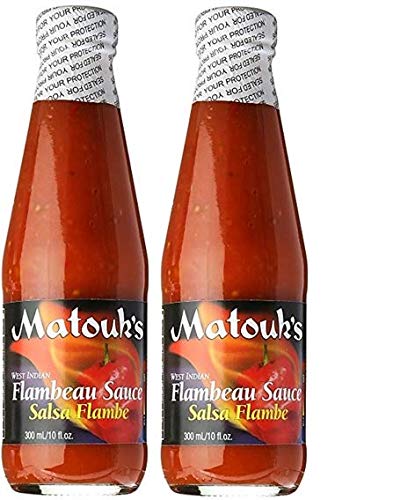
You know that feeling when you grab a bottle of hot sauce off a shelf in a Caribbean grocery store, bring it home, and two weeks later you’re rationing the last few drops because you can’t find it anywhere nearby? That’s the Matouk’s experience for a lot of diaspora cooks — you discover it in a Trinidadian household, or on a dive trip in the Bahamas, or at a relative’s Sunday lunch table where it sits next to the ketchup like it’s the most normal thing in the world. And then you’re back home in Brooklyn or Toronto or London, staring at three different Matouk’s bottles on a specialty store shelf — Flambeau, West Indian Hot, and Calypso — wondering which one is the one you remember, and whether the other two are worth the shelf space.
This article is the cheat sheet. We’re going to break down what each bottle actually does, where each one earns its place (table condiment, marinade base, curry companion), and how to decide which to buy first — or whether you grab the variety pack and skip the guesswork entirely.
Why Matouk’s Reads Differently Than Every Other Hot Sauce in the Aisle
Before comparing the three bottles, it’s worth understanding why longtime users describe Matouk’s with a loyalty that’s almost unusual in the hot sauce category. Smithsonian Magazine, in its coverage of Trinidad’s identity as a condiment capital of the Caribbean, notes that the island’s culinary character is built on layered seasoning — not just heat, but an architecture of flavor that includes fruit, allspice, and aromatics working together. Matouk’s embodies that architecture. The brand has been producing sauces in Trinidad since the 1930s, and the base formula uses scotch bonnet peppers — a fruity, intensely hot variety closely related to habanero, common across the Caribbean and registering between 100,000 and 350,000 Scoville heat units (for reference, a jalapeño tops out around 8,000) — alongside papaya or mango as a softening, textural element.
That fruit-forward backbone is what separates Matouk’s from a Louisiana-style vinegar-and-cayenne sauce or a pure Mexican-style chili mash. Serious Eats, in its writing on scotch bonnet and habanero heat, explains that the fruity aroma compounds in these peppers are what make them feel “bright” rather than simply aggressive — and that fruitiness is why Matouk’s works as a table condiment in a way that a straight scotch bonnet mash wouldn’t. You’re not just adding fire; you’re adding a flavor dimension.
Taste Atlas, in its regional condiment profiles, describes Matouk’s as functioning like ketchup on a Trinidadian table — a default condiment that sits out at every meal rather than being reserved for specific applications. That “equivalent to ketchup” framing, which food writers and reviewers arriving from the Bahamas, Jamaica, and Trinidad independently reach, is the most important thing to understand about the brand before you start comparing bottles.
The Three Bottles, Mapped
The comparison below organizes each bottle by its practical role in the kitchen. All three share the same scotch bonnet-and-fruit foundation; the differences are in heat level, consistency, and where each sauce performs best.
Matouk’s Flambeau: The Loyalist’s Bottle
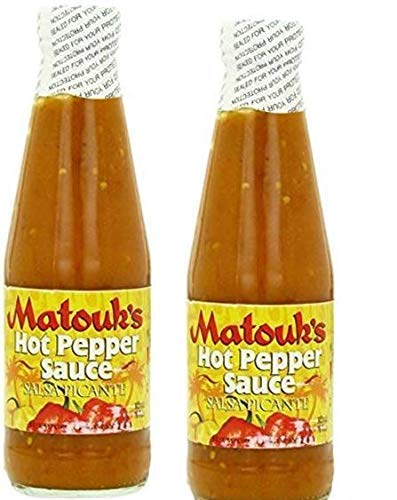
Flambeau is the one with the longest paper trail of devotion. Among long-term buyers, it’s common to find cooks who have been reaching for Flambeau for over 30 years — that kind of loyalty is rare in a category where brands rise and fall on hype cycles. What keeps people returning isn’t novelty; it’s consistency.
Flambeau is the hottest of the three core bottles. It leans into the scotch bonnet’s full heat range and carries a thicker, more textured consistency than West Indian Hot. Long-run users consistently describe it as the sauce they reach for when they want the pepper’s presence to be unmistakable — not a background note, but the main event. It performs in cooked applications particularly well: stirred into stew chicken during the last ten minutes, folded into a pepper sauce base, or used as a finishing drizzle over rice and peas where you want the heat to land cleanly.
Saveur, in its feature on the hot sauces of the Caribbean, observes that the best regional hot sauces function as seasonings in cooking rather than as afterthoughts on the plate — Flambeau fits that description precisely. It’s a stove bottle as much as a table bottle.
Family-dinner-safe rating: Use cautiously with heat-sensitive guests. Flambeau earns its fire-breathing reputation — not at the level of a pure extract sauce, but firmly in the “serious heat” category that newcomers should approach with a test-dab first.
Best for: Heat loyalists, cooked Caribbean dishes, stew chicken, pepper sauce bases.
Matouk's
$21.99
In stock on Amazon
Check price on AmazonMatouk’s West Indian Hot: The Everyday Workhorse
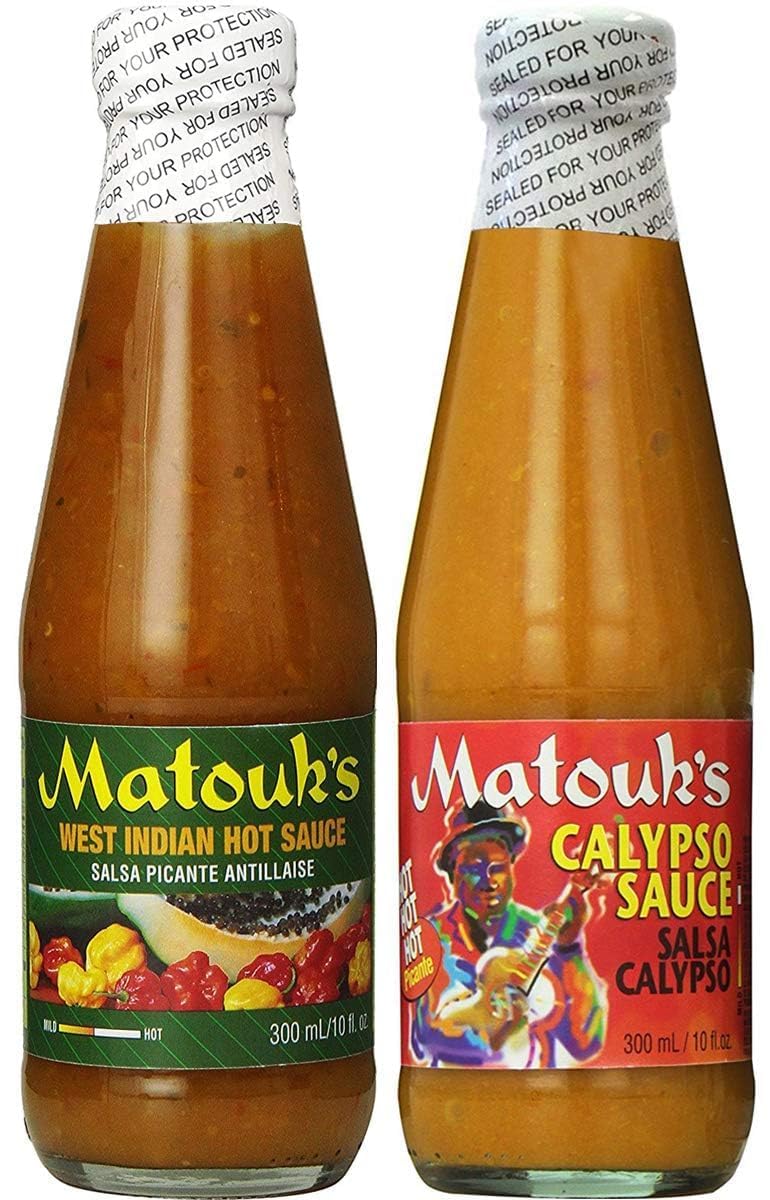
West Indian Hot is the closest to the “ketchup on the table” archetype. It’s milder than Flambeau — approachable enough for family tables that include children or heat-cautious eaters — but it carries the same scotch bonnet fruitiness and the same Trinidadian flavor logic. Think of it as Flambeau with the volume turned to a level where you can use a generous pour rather than a careful drop.
One pricing note worth flagging honestly: in cities with strong Caribbean grocery infrastructure — Brooklyn’s Flatbush corridor, Toronto’s Scarborough, Miami’s Little Haiti — West Indian Hot tends to appear on Caribbean specialty store shelves at prices significantly below online retail. The online premium is a diaspora tax you don’t have to pay if local stock is available. If you’re in one of these metro areas, check the Caribbean grocery shelf first.
West Indian Hot’s consistency is slightly thinner than Flambeau, which makes it pour easily and incorporate quickly. It’s the sauce that disappears fastest in a household that uses it daily — which is the best argument for buying it in multiples or keeping an eye on restocks. The Spruce Eats, in its guides to Caribbean pantry staples, consistently flags Matouk’s West Indian Hot as one of the foundational condiments for a Caribbean-influenced home kitchen, precisely because of its versatility as a daily pour.
Family-dinner-safe rating: Yes, with confidence. It has presence and heat, but it doesn’t dominate the table.
Best for: Everyday table use, households with mixed heat tolerance, daily pour over anything from eggs to rice.
Matouks
$16.83
In stock on Amazon
Check price on AmazonMatouk’s Calypso: The Surprising Cross-Cultural Performer
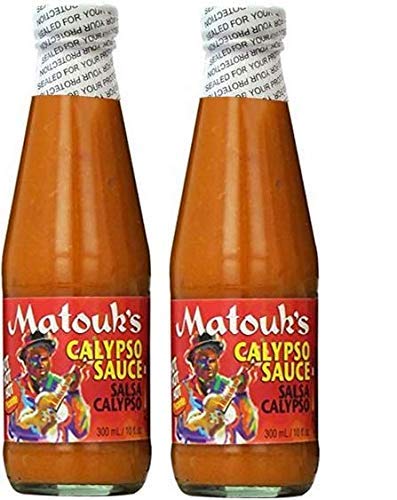
Calypso is the one that consistently surprises people who come to Matouk’s expecting a straightforward heat spectrum. It’s the mildest of the three, but describing it as “mild” undersells what it’s actually doing. Calypso is the most fruit-forward of the lineup — the mango and papaya elements are more pronounced, the scotch bonnet heat is dialed back, and the overall profile reads as a condiment sauce as much as a hot sauce.
Calypso’s most revealing use-case comes from Indo-Caribbean cooking contexts — dishes that fuse South Asian spice traditions with Caribbean ingredients. Cooks in that tradition describe Calypso as holding up against the heavy spice architecture of a curry dish without creating flavor dissonance, a quality that makes it genuinely useful in a culinary world where most hot sauces either get lost in curry or fight against it. That’s not a trivial data point. Indo-Trinidadian cooking is a distinct and sophisticated culinary tradition, and a sauce that navigates that fusion confidently earns its place on the counter.
Calypso also works as a finishing sauce and dipping condiment in ways that Flambeau doesn’t quite reach. Where Flambeau asks for respect, Calypso invites generous use. It’s the bottle you put out when you’re cooking for a mixed-heat crowd, or when you want the scotch bonnet’s flavor without its full commitment to heat. Taste Atlas, in its regional condiment profiles, notes that the most enduring Caribbean condiments tend to be the ones that function across multiple meal contexts — Calypso fits that description more flexibly than either of its bottle-mates.
Family-dinner-safe rating: Yes — this is the one newcomers to scotch bonnet heat should start with.
Best for: Indo-Caribbean pairing, curry companion, dipping, first-time buyers, children at the table.
Matouks
$14.02
In stock on Amazon
Check price on AmazonSide-by-Side: Quick Reference
| Bottle | Heat Level | Consistency | Primary Role | Tier |
|---|---|---|---|---|
| Flambeau | High | Thick | Cooking sauce, serious heat | Matouk’s — $21.99 |
| West Indian Hot | Medium | Pourable | Daily table condiment | Matouks — $16.83 |
| Calypso | Low-Medium | Pourable | Dipping, curry, newcomers | Matouks — $14.02 |
Heat levels are relative within the Matouk’s lineup, not absolute Scoville rankings. All three bottles use scotch bonnet peppers as their base.
The Variety Pack Decision: Math and Logic
The 2-pack and 3-pack variety sets come up consistently in the buying conversation, and the calculus is fairly straightforward. Saveur, in its coverage of Caribbean hot sauce collections, notes that variety packs serve two distinct buyer types: the flavor-explorer who wants to map a brand’s range before committing to a single bottle, and the household stacker who knows they’ll use multiple bottles and wants the bundled value.
If you’ve never tried Matouk’s at all, the 3-pack is the efficient entry point. You get to confirm which bottle you reach for most, which tells you exactly what to reorder in bulk. If you already know you’re a West Indian Hot household but want to keep a Flambeau on the stove for cooking applications, the 2-pack is a cleaner buy. The per-bottle price in bundles typically reflects a modest discount over individual bottle pricing — not dramatically so, but enough to make the variety pack logical if you’re confident you’ll use what you receive.
The diaspora pantry story that keeps resurfacing — discovering Matouk’s on a trip, not finding it in the airport on the way home, scrambling to source it back in your home city — is the reason the variety pack exists as a category. It’s the buy that closes the supply-chain anxiety loop.
Frequently Asked Questions
What is the actual flavor difference between Matouk’s Flambeau and Matouk’s West Indian Hot — is it just heat level?
It’s not just heat. Flambeau is thicker and more intensely pepper-forward, with the scotch bonnet’s character fully expressed. West Indian Hot is slightly thinner, a touch milder, and has a fruitier, more balanced profile that makes it easier to pour freely. Think of Flambeau as the concentrated version and West Indian Hot as the daily-use iteration.
Is Matouk’s Calypso hot enough to count as a hot sauce or is it more of a flavor sauce?
It counts as both, depending on your heat baseline. For anyone with moderate-to-high heat tolerance, Calypso reads primarily as a flavor sauce — the scotch bonnet fruity character is present, but the heat is restrained. For heat-cautious eaters, it will still register as a hot sauce. The better frame: it’s a scotch bonnet condiment that prioritizes flavor delivery over heat impact.
Why does Matouk’s taste different from other habanero hot sauces I’ve tried?
The papaya and mango in the base formula. Most American habanero hot sauces use vinegar and salt as the primary supporting elements, which pushes the pepper’s heat to the front. Matouk’s uses fruit as a structural ingredient, which creates textural body and a brightness that tempers the heat and adds a distinctly Caribbean flavor profile. Serious Eats, in its writing on scotch bonnet and habanero aromatics, explains that the fruity compounds in these peppers are intensified — not dulled — when paired with tropical fruit.
Can I find Matouk’s in Caribbean grocery stores in the US or do I have to buy it online?
In cities with large Caribbean diaspora populations — New York, Miami, Toronto, London — Matouk’s West Indian Hot in particular tends to appear on Caribbean grocery shelves, sometimes at prices significantly below online retail. Flambeau and Calypso are less consistently stocked and more likely to require an online order. If you’re outside a Caribbean population center, online sourcing is generally your most reliable route.
Is the Matouk’s 2-pack or 3-pack variety set good value compared to individual bottles?
Modestly, yes. The per-bottle price in variety sets typically reflects a small discount, and more importantly, the variety set lets you map the lineup before committing to a single bottle in bulk. For a first purchase, the 3-pack is the smart play. For a household that has already identified its daily bottle, individual restocks or bulk single-bottle orders may be more practical.
Which Matouk’s sauce works best in cooked dishes versus as a table condiment?
Flambeau is the cooking sauce — its heat and thickness stand up to long applications and hold their character in stews, braises, and marinades. West Indian Hot is the table condiment, optimized for daily pouring. Calypso excels as a finishing sauce and in pairing contexts like curry, where its milder profile and fruit-forward character add without overwhelming.
The Decision Rule
Here’s the “if X, then Y” frame for anyone with a decision pending:
- If you’re buying Matouk’s for the first time: Start with the 3-pack variety set. Map the lineup, then reorder the bottle you emptied first.
- If you want one bottle for a daily table condiment: West Indian Hot. Check a local Caribbean grocery store before ordering online — you may find it at significantly better pricing.
- If you cook Caribbean food from scratch and want a sauce for the stove: Flambeau is your workhorse. Treat it like a seasoning, not a condiment.
- If you’re cooking for an Indo-Caribbean household or pairing with curry dishes: Calypso is the unexpected correct answer — its fruit-forward profile navigates complex spice without creating dissonance.
- If you’re gifting to someone who discovered Matouk’s on a trip and can’t find it locally: The variety 3-pack closes the diaspora supply-chain loop and gives them the whole map of the brand. It’s the curated pantry gift that actually gets used.