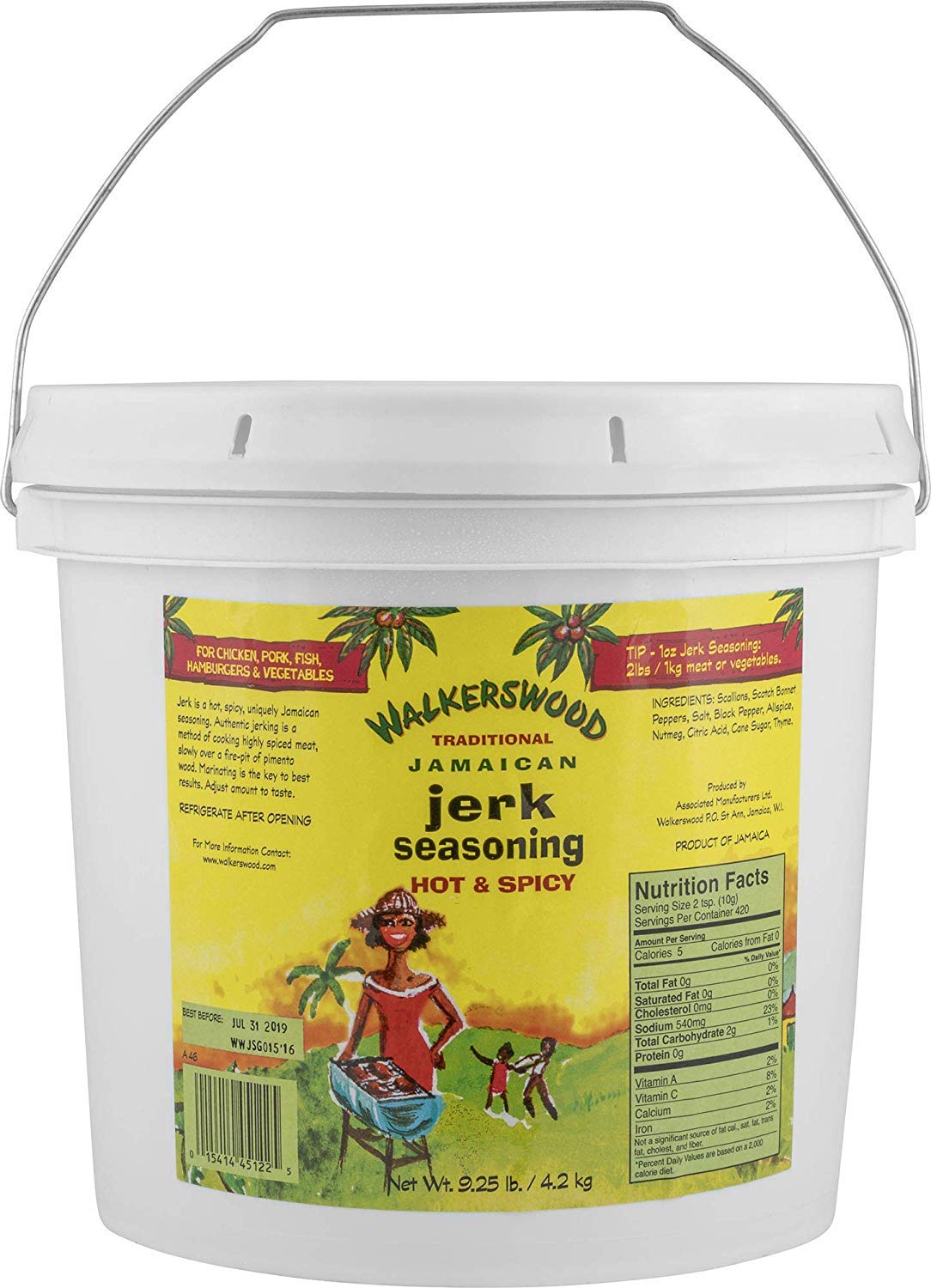
You know that feeling when you finally crack open a fresh jar of Walkerswood Traditional Jerk Seasoning — that hit of scotch bonnet heat, allspice (the dried berry of the Pimenta dioica tree, sometimes called “pimento” in Caribbean cooking), and thyme that instantly smells like a Kingston backyard grill — and then you realize the standard 10-oz retail jar is going to last you exactly two cookouts? That’s the moment most serious home cooks start eyeing the catering jar: the large-format tub (typically 4 lbs / ~1.8 kg) that Walkerswood produces for commercial kitchens and food-service buyers. It’s a bigger upfront spend — usually $20–30 depending on the retailer and whether you’re buying in-store or through a Caribbean specialty distributor — but the per-ounce math changes dramatically. This guide is for cooks who are past the “let me try a small jar” phase and are now asking the smarter question: when does the bulk buy actually win, and once you’ve got that big tub, how do you make sure the last tablespoon tastes as good as the first?
| EDITOR'S PICKWalkerswood Traditional Jamaica… | Mid-tierIsland Spice Jerk Seasoning 32… | Budget pickSpur Tree Jamaican Jerk Seasoni… | |
|---|---|---|---|
| Size | 142 fl oz | 32 oz | 35 oz |
| Form | — | Dry rub | Sauce |
| Heat level | Mild | — | — |
| Gluten-free | — | ✓ | — |
| Vegan | — | ✓ | — |
| Pimento | — | ✓ | — |
| Price | $47.99 | $22.97 | $15.99 |
| See on Amazon → | See on Amazon → | See on Amazon → |
The Per-Ounce Math: Does the Catering Jar Actually Save You Money?
Let’s do the arithmetic plainly, because the sticker price of the catering jar can feel intimidating if you haven’t run the numbers.
By the numbers (May 2026 market pricing, Caribbean specialty retail):
| Format | Typical Price | Net Weight | Price per Oz |
|---|---|---|---|
| Retail jar (standard) | $8–10 | 10 oz | ~$0.90–1.00/oz |
| Retail jar (large) | $13–16 | 17 oz | ~$0.76–0.94/oz |
| Catering jar | $20–30 | 64 oz (4 lb) | ~$0.31–0.47/oz |
The catering jar lands at roughly one-third the per-ounce cost of the standard retail jar when you find it at the lower end of that range. Even at $30, you’re at $0.47/oz versus a dollar-plus for the small jar. If you’re marinating chicken thighs for a family cookout every other weekend, or running a weekly meal-prep routine that hits jerk chicken, jerk tofu, or jerk pork shoulder, you can burn through a standard jar in six to eight weeks. The catering jar, at that same cadence, could last four to six months — at which point storage becomes the critical variable (more on that below).
Per the Jamaica Observer’s feature on Walkerswood’s production history, the brand has been operating out of the Walkerswood village in St. Ann Parish, Jamaica, since 1978 — making it one of the few major jerk seasoning brands that is genuinely Jamaica-made and still village-rooted rather than offshore-licensed. That provenance matters to this audience, and it’s worth noting that the catering jar carries the same Walkerswood recipe as the retail jar; you’re not getting a diluted or reformulated product. The ingredient list is unchanged: scotch bonnet peppers, scallions, salt, black pepper, allspice, nutmeg, citric acid — no fillers added for volume.
When the Bulk Buy Makes Sense (and When It Doesn’t)
This is where the decision frame matters. Not every household should be buying catering jars, and buying big when the conditions aren’t right leads to waste — which erases every penny of the per-ounce savings.
Buy the catering jar if:
-
You cook Caribbean food at least twice a month, year-round. Walkerswood is shelf-stable before opening, but once you crack that lid, the clock starts. If your jerk seasoning use is seasonal — big for summer grilling, near-zero in winter — the catering jar becomes a liability.
-
You batch-cook or meal prep. Anyone who preps four or more pounds of protein weekly will hit the bottom of a retail jar in under a month. The catering format is built for this rhythm.
-
You’re feeding a crowd regularly. Hosting a summer cookout for 20 people? A single catering jar handles the marinade for roughly 15–20 lbs of chicken thighs (a standard usage rate runs 1–2 tablespoons per pound of meat, per Serious Eats’ marinade science coverage, which notes that acid-and-salt-forward marinades like jerk benefit from generous application to penetrate efficiently).
-
You have a dedicated cool, dark storage space. A basement pantry, a cool cabinet away from the stove — not a shelf above the oven.
-
You split it. This is the move many diaspora households overlook: the catering jar is easily portioned into two or three secondary containers and shared across family members or cooking-circle friends. You each pay $8–10 and walk away with what amounts to two retail jars’ worth of product.
Skip the catering jar if:
- You cook jerk dishes fewer than twice a month. The math stops working, and you risk the quality degradation that comes from a half-used tub sitting in the fridge for nine months.
- You have no reliable refrigerator space to commit once the jar is open.
- You’re still calibrating how much heat your household tolerates. Walkerswood Traditional is not a mild seasoning — Saveur’s jerk guide characterizes it as genuinely hot, with scotch bonnet peppers (which register 100,000–350,000 Scoville Heat Units, compared to a jalapeño’s 2,500–8,000) as the lead pepper. If you’re still navigating heat tolerance, a retail jar lets you experiment before committing.
Storage: The Part That Determines Whether the Bulk Buy Was Worth It
Food52’s coverage of spice paste storage makes the core point cleanly: the enemies of an opened jar of jerk seasoning are air, heat, and cross-contamination from wet or food-coated spoons. Get those three variables under control and a catering jar holds its quality for four to six months after opening under refrigeration. Let them run loose and you’re looking at off-flavors, mold at the jar’s shoulder, and wasted product within six to eight weeks.
The USDA Food Safety and Inspection Service’s refrigeration guidance establishes the baseline: high-acid, high-salt condiment pastes like jerk seasoning are generally safe refrigerated in sealed containers for several months, but quality (flavor intensity, color, aroma) degrades faster than safety — meaning the seasoning may be technically safe to eat long after it’s lost the punch that made it worth buying in the first place.
Here’s the practical protocol, built around what owners of large-format Caribbean condiment jars consistently report as the winning approach:
1. Portion immediately on opening. Don’t live out of the catering jar. The moment you open it, divide it into two or three smaller airtight containers — ideally glass jars with tight lids. Keep one working jar in the refrigerator for active use. Store the remainder in the back of the fridge or, for the longest horizon, in the freezer.
2. Use dry, clean utensils every single time. A wet spoon or one that’s touched raw meat introduces moisture and contamination into the jar. This is the single most common reason a large-format jar goes off faster than it should. Owners who report disappointing shelf life almost always trace it back to this habit.
3. Freezer storage is underused and genuinely effective. Jerk seasoning paste freezes exceptionally well. The high salt and acid content means it doesn’t freeze into a solid brick — it remains scoopable at typical freezer temperatures (-0°F / -18°C). Portion into ice cube trays, freeze, then transfer the cubes to a zip-lock bag. Each cube is roughly 1–2 tablespoons, which maps neatly to single-use marinade portions. This approach extends quality to 12 months or beyond.
4. Mark your jar. Write the open date on the lid with a marker. This sounds trivial, but anyone who’s done a fridge audit on a busy household knows that unlabeled jars become mystery objects within eight weeks.
5. Watch for these signs of quality loss (not necessarily spoilage, but flavor degradation worth knowing):
- Color shifts from deep olive-green to brownish-grey at the surface (oxidation; stir it down and use promptly)
- Separated liquid pooling at the top (normal; stir to reincorporate)
- Loss of the sharp scotch bonnet aroma on opening (the volatile oils have dissipated; the seasoning is still usable but less potent)
Sourcing the Catering Jar: Where to Find It and What to Expect
The Walkerswood catering jar isn’t always on the shelf at a general grocery store. Distribution runs through Caribbean specialty retailers, restaurant supply distributors, and select online Caribbean pantry storefronts. Pricing varies meaningfully: Caribbean grocery stores in diaspora-dense cities (Toronto, Brooklyn, South Florida, the UK’s Brixton market corridor) often carry it in-store at the lower end of the $20–25 range. Online specialty retailers — including Caribbean pantry storefronts — typically land in the $22–30 range before shipping.
One note on shipping: jerk seasoning paste is heavy. A 4-lb jar adds significant shipping weight, which can push a “good deal” into marginal territory if you’re paying standard rates. If you’re ordering online, look for free-shipping thresholds or bundle the catering jar purchase with other pantry staples (a bottle of Marie Sharp’s Habanero Pepper Sauce, a bag of roti flour, a few cans of Grace ackee) to get the per-item shipping cost down. That’s how the bulk buy math fully closes.
The Decision Rule
If you cook Caribbean food at least twice a month, have reliable refrigerator space, and are willing to portion and freeze properly: the catering jar is the clear buy. You’re looking at 50–65% savings per ounce versus the retail jar, with identical product quality, from a brand whose Jamaica-made provenance is about as clean as it gets in the jerk seasoning category.
If your usage is seasonal, your fridge is tight, or you’re still calibrating heat tolerance in your household: stay with the retail jar, or split a catering jar with a cooking-circle friend. The savings are only real if the product gets used.
The catering jar rewards the cook who treats their pantry as infrastructure — not an afterthought. Stock it right, store it properly, and Walkerswood becomes the kind of constant you stop thinking about, because it’s always there when you need it.