You know that feeling when you’re standing in a Caribbean grocery aisle holding two bottles of hot sauce — one costs $8, one costs $14 — and you genuinely can’t tell whether the premium is worth it, or whether both are going to taste vaguely the same once they hit your plate? Now multiply that uncertainty by the pressure of buying one as a gift. Caribbean hot sauces are not a monolith. They range from smooth, fruity, vinegar-forward Trinidadian-style pepper sauces to thick, smoky Jamaican scotch bonnet (a small, lantern-shaped chili that punches hotter and fruitier than a standard habanero) pastes — and the difference matters enormously to the person receiving them. This guide is built to help you navigate that range confidently: we’ll break down the major gift formats (single bottles, variety packs, and curated gift boxes), name the tradeoffs between them, and give you a clear decision rule at the end so you’re not second-guessing your cart.
| EDITOR'S PICKAunt May's | Mid-tierMatouk's Flambeau West Indian a… | Budget pickQueen Majesty Scotch Bonnet & G… | |
|---|---|---|---|
| Size | 12 fl oz | 10 oz | 5 oz |
| Pack count | 1 | 3 | 1 |
| Dietary | — | — | Vegan, Kosher, Gluten Free |
| Sugar-free | — | — | ✓ |
| GMO-free | — | — | ✓ |
| Awards | — | — | ✓ |
| Price | $24.77 | $23.53 | $14.99 |
| See on Amazon → | See on Amazon → | See on Amazon → |
Why Caribbean Hot Sauce Is a Serious Gift Category Now
This is not a novelty pepper-sauce-of-the-month situation. Caribbean hot sauce occupies a genuinely distinct flavor lane that food culture has been slow to document properly — and that gap is closing fast. Taste Atlas’s regional flavor profile documentation for Trinidad pepper sauce notes its characteristic balance of scotch bonnet heat, chadon beni (also spelled shado beni — a serrated Caribbean herb that tastes like a more complex, slightly citrusy version of cilantro), and vinegar brine. That combination doesn’t exist in mass-market American hot sauce. When you give someone a well-chosen Caribbean sauce, you’re handing them an ingredient that changes how they cook, not just a condiment they shake on wings.
The gifting market has caught up. As of mid-2026, curated Caribbean condiment sets in the $30–$80 range have become a real category at specialty importers and diaspora-owned online stores. The premium is driven partly by provenance — bottles that are actually made on-island, not reformulated for a North American co-packer — and partly by formats: variety packs and gift boxes that let a recipient explore a brand’s heat spectrum rather than committing to one profile blind.
The core decision you’ll make in this guide:
- Single bottle (~$10–$15): right for a specific craving or a pantry gap
- Variety pack (~$25–$45): right for exploration, works as a hostess or housewarming gift
- Gift box / curated set (~$45–$120): right for a serious food lover, a holiday, or someone building a condiment collection
Bertie’s Gift Box: The Trinidad Purist Case
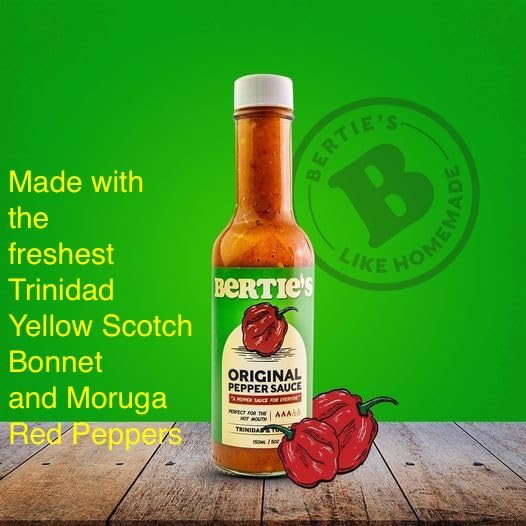
Bertie’s Trinidad Pepper Sauce is a small-batch, Trinidad-origin brand built around the traditional chadon beni–scotch bonnet–mustard base that defines the country’s pepper sauce tradition. If you are buying for someone who cooks Trinidadian food seriously — pelau, doubles, stewed chicken — or for a diaspora household that grew up eating this style, Bertie’s is the provenance argument. Smithsonian Magazine’s coverage of the Caribbean pantry and its diaspora journey highlights exactly this dynamic: island-made small-batch sauces carry cultural weight that a mass-market bottle cannot replicate, and gift buyers in diaspora communities are willing to pay for that.
Bertie’s gift box format typically bundles two to three sauce variants (a classic green chadon beni sauce, a red scotch bonnet version, and sometimes a shadow beni–heavy seasoning paste) with enough volume to actually cook with rather than just sample. Reviewers who have purchased the gift sets consistently describe the flavor as “bracingly fresh” relative to bottled competitors — a quality attributed to shorter shelf-stabilization processing.
Tradeoff to name explicitly: Bertie’s heat level sits in the medium-hot range for the scotch bonnet bottle — Saveur’s Caribbean pepper sauce feature places traditional Trinidad-style sauces at roughly 100,000–350,000 Scoville heat units (SHU) depending on preparation, with chadon beni-forward versions on the lower end. That’s family-dinner-safe for experienced scotch bonnet eaters, but potentially incapacitating for someone who considers Cholula “spicy.” Know your recipient’s baseline before you commit to the all-scotch-bonnet gift tier.
Price math: Bertie’s gift boxes typically land at $48–$65 for a three-bottle set through specialty Caribbean importers. At roughly $16–$22 per bottle with gift packaging, you’re paying a modest premium over buying singles — the uplift is real but not egregious, and the presentation justifies it for a gift context.
Matouk’s Variety Packs: The Calibrated Entry Point
Matouk’s is a Trinidad-based brand (Trinidad and Tobago-owned and produced, family-run since 1962) that has the widest distribution of any serious Caribbean hot sauce in North American diaspora markets. The Jamaica Observer and regional Caribbean food press consistently reference Matouk’s Calypso Sauce and its Flambeau Hot Sauce as benchmark products for the category. This is not a knock-off situation — Matouk’s is legitimate, island-made, and formulated with real scotch bonnet and habanero peppers.
The variety pack format is where Matouk’s earns its gift-guide position. Their multi-bottle sets typically span:
- Calypso Sauce — fruit-forward (papaya base), medium heat (~50,000–80,000 SHU estimated), the most accessible entry in the lineup
- West Indian Hot Sauce — more vinegar-forward, thinner body, higher heat, built for splashing onto food rather than using as a cooking base
- Flambeau Hot Sauce — their flagship scotch bonnet sauce, fuller flavor, sitting at the higher end of their heat spectrum
By the numbers:
| Format | Approx. Price | Per-Bottle Cost | Best For |
|---|---|---|---|
| Single bottle (5 oz) | $10–$14 | $10–$14 | Pantry restock, known preference |
| 3-pack variety | $28–$38 | $9–$13 | Gifting, exploration, mixed households |
| 5-bottle set | $44–$58 | $9–$12 | Serious collectors, holiday gift tier |
The per-bottle math on variety packs is essentially break-even or modestly favorable versus singles — you’re not overpaying for the bundle. The gift value is in curation and presentation, not in discount. Serious Eats’ explainer on scotch bonnet peppers versus habaneros is useful context here: Matouk’s Calypso line leans on the fruity-tropical top notes that both peppers share, which makes it a safer exploratory gift than an undiluted scotch bonnet mash.
Tradeoff: Matouk’s wide distribution is a double-edged signal. A recipient who already stocks their pantry seriously may already own the Calypso sauce. If you know they’re a Matouk’s buyer, go single-bottle of the harder-to-find Flambeau, or pivot to a brand they haven’t encountered. If you don’t know their pantry, the variety pack is the safest choice in this price tier — you’re almost certainly filling at least one gap.
Other Sauces Worth Building Into a Gift Set
If you’re assembling a curated multi-brand box rather than buying a pre-packaged set, here are the additions that fill out a complete Caribbean heat spectrum:
Marie Sharp’s Habanero Pepper Sauce (Belize, $10–$15/bottle) — Belize-made, not Caribbean-island in the strictest sense but widely stocked alongside Caribbean sauces in diaspora grocery channels, and genuinely excellent. The habanero-carrot base is fruit-forward and deeply aromatic. Reviewers across specialty food communities consistently flag the Beware variety (their hottest tier) as a gift-worthy attention-getter. Build this into a set if your recipient has expressed interest in the full habanero-adjacent family.
Walkerswood Traditional Jerk Seasoning — Technically a paste rather than a pourable sauce, but it earns a place in any serious Caribbean condiment gift. Jamaica Observer reporting confirms Walkerswood’s production remains Jamaica-based and family-rooted. The catering-size jar ($20–$30) is a genuinely generous gift for someone who cooks; the standard retail jar ($8–$12) works as a set component.
Grace Scotch Bonnet Pepper Sauce — The entry-level accessible option. At $5–$8 per bottle, it’s the right piece to include in a gift set when you want to cover the spectrum from accessible to intense without the whole package skewing intimidating. Taste Atlas documentation consistently places Grace-style Jamaican scotch bonnet sauces as the reference point for introducing newcomers to the flavor profile.
Small-batch shadow beni (chadon beni) sauces — If you can source a small-batch chadon beni-forward green sauce from a Trinidad or diaspora producer, this is the element that makes an assembled box feel genuinely curated rather than just expensive. The herb itself (explained earlier as the serrated, citrusy Caribbean cousin of cilantro) is what separates a Trinidad-style sauce from everything else in the hot sauce world. This is the component most likely to be new to the recipient and the one that generates the most “where did you find this?” responses.
The Decision Rule
Here’s where the tradeoff framework collapses into a usable action:
If your recipient is a Caribbean heritage cook or serious diaspora household: Lead with Bertie’s gift box or a Matouk’s 5-bottle set. They’ll recognize the provenance, and a small-batch or full-spectrum set tells them you did the homework. Budget $45–$80.
If your recipient is food-curious but not a Caribbean cook specifically: The Matouk’s 3-pack variety is the cleanest answer — accessible heat range, real island-made quality, approachable price, and enough variety to generate actual excitement. Budget $28–$40.
If you’re assembling a custom set: Anchor with Walkerswood jerk paste (familiar brand name, high usefulness), add one Matouk’s bottle for pourable sauce coverage, and include one chadon beni or small-batch scotch bonnet sauce as the discovery element. Total outlay of $35–$55 depending on sourcing, and you’ve covered Jamaican, Trinidadian, and discovery lanes in one package.
The heat warning you must not skip: Any set that includes full scotch bonnet or habanero sauces (rated 100,000 SHU and above) needs a note attached. A small handwritten card with “this one is genuinely hot — start with a quarter teaspoon” is not condescending; it’s the difference between a gift that gets used and a bottle that lives in the back of the pantry forever. Family-dinner-safe picks are Grace Scotch Bonnet Sauce, Matouk’s Calypso, and any chadon beni–forward green sauce. Fire-breathing tier: Matouk’s Flambeau, Marie Sharp’s Beware, and any undiluted scotch bonnet mash. Label accordingly and let the recipient decide their own ceiling.
The Caribbean hot sauce category rewards the buyer who does twenty minutes of research. You’ve now done it.